when ur hanging out in ur apartment u’ve got some candles lit ur feeling good u’ve had 8 glasses of wine then down in the street u hear two beautiful boys skateboarding or doing flips or something so u invite them up and they say where’s the bed and they ask if they can sit on the bed and u tell them sure but the sheets are expensive japanese linen and they tell u they’re not even soft:
The catalyst was a customer — a father of four who had put his hand up the shirt of a busser clearing his family’s table. The busser was so stunned she didn’t report it, but the event sparked a flood of reactions from staff members who’d had similar experiences. At our meeting, women shared stories about harassment from customers and said that when they tried to report it to male managers, they were often ignored because the incidents seemed unthreatening through a male lens.
We decided on a color-coded system in which different types of customer behavior are categorized as yellow, orange or red. Yellow refers to a creepy vibe or unsavory look. Orange means comments with sexual undertones, such as certain compliments on a worker’s appearance. Red signals overtly sexual comments or touching, or repeated incidents in the orange category after being told the comments were unwelcome.
When a staff member has a harassment problem, they report the color — “I have an orange at table five” — and the manager is required to take a specific action. If red is reported, the customer is ejected from the restaurant. Orange means the manager takes over the table. With a yellow, the manager must take over the table if the staff member chooses. In all cases, the manager’s response is automatic, no questions asked. (At the time of our meeting, all our shift managers were men, though their supervisors were women; something else we’ve achieved since then is diversifying each layer of management.)
In the years since implementation, customer harassment has ceased to be a problem. Reds are nearly nonexistent, as most sketchy customers seem to be derailed at yellow or orange. We found that most customers test the waters before escalating and that women have a canny sixth sense for unwanted attention. When reds do occur, our employees are empowered to act decisively.
The color system is elegant because it prevents women from having to relive damaging stories and relieves managers of having to make difficult judgment calls about situations that might not seem threatening based on their own experiences. The system acknowledges the differences in the ways men and women experience the world, while creating a safe workplace.
Hey, do you know that feeling of hitching up a long skirt so you don’t fall on your face when walking upstairs, and then you immediately become a wretched yet resolute Jane Austen character? It’s a universal thing, right?
It’s like resting a laundry basket against your hip and suddenly you’re a long-suffering peasant woman, wondering if you’ll survive the winter.
Is this what you guys think it means when GMO comes up in conversation?
Do you know what else is a GMO?
Dogs. Literally ALL dogs have had their genetics modified to make them more docile, loyal, trusting, energetic, obedient ect.
Ears of corn used to be the size of your thumb. Through selective ‘breeding’ we chose the strains of corn that were the biggest, fastest growing, most resilient ect. Ect.
THAT is a GMO. I don’t know where the idea that genetic modification meant they’re injecting your food stuffs with chemicals to change its DNA. That’s not how it works.
However, they ARE spraying your veggies with pesticides and that is something you should be worried about.
Companies like Monsanto are evil. But not because they are breeding crops to feed more people. But because they’re monopolizing the farming market, sueing farmers who share a geographic area and have some of the same strains of crops in their fields because of unavoidable cross pollination and lying about their business practices.
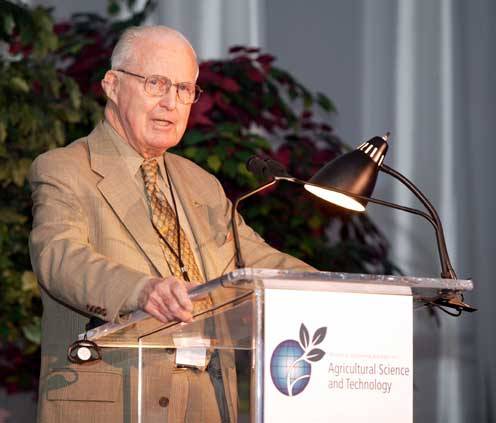
This is Normal Borlaug. In 1942 he received his Ph. D in plant pathology and genetics. In Mexico, he developed semi-dwarf, high-yield, disease resistant varieties of wheat. A genetically modified food. He introduced these to Mexico, Pakistan and India, resulting in double the wheat yields in a 5 year span. In 1970, Borlaug was awarded the Nobel Peace Prize, for saving one billion lives from starvation, and contributing to world peace through increasing the world food supply.
Genetically modified food is great.
This, a thousand fucking times this. Privilege is spouting and spreading pseudo-science bullshit you saw on your Facebook feed or on Twitter because unlike people in drought and famine prone areas of the world, you have the option to do just that. Those other parts of the world that don’t have the benefit of a food surplus and can’t pick and choose what they eat depend on GMOs to not die of starvation or watch their children waste away.
I despise Monsanto as much as the next person and if they ever go out of business, I’ll be the first to dance a jig, but condemning GMOs just because one megacorp is a pile of shitbags is beyond idiotic. If scientists can create new strains of seeds that can withstand disease, pests, all while yielding more foodstuff, then we should be throwing our support behind them.
Also, “They are feeding us chemicals!” is a fundamentally ridiculous statement.
Why?
As a chemist, I’m gonna let you in on a little secret:
Everything is chemicals.
GMO scaremongering is second only to vaccine scaremongering
I always laugh when people say “there are chemicals in my food!” because buddy…. you are chemicals. People are literally made of organic compounds, which are… chemical compounds with carbon in ‘em. YOU ARE THE CHEMICALS
Chemicals in my me?
Things not considered GMO: Literally using chemicals to randomly mutate DNA (Ethyl methanesulfonate (EMS))
Things considered GMO: Targeted mutagenesis via transposons or viruses, double haploid mutagenesis, induced polyploidy (like in wheat, bananas, strawberries), using plant bacteria as vectors to introduce new DNA, chloroplast engineering etc.
Products that contains traces of the genetic engineering process are considered GMOs that need to undergo regulatory approval from the FDA/EPA or EFSA (if you’re in Europe) which ironically enough, the chemical induced mutagenesis is not considered that unlike the others in the GMO list. Even the chemical mutagenesis ones has to undergo strict selection processes, literally tens of thousands of plants gets cross-bred together to establish a line of consistent trait expression so none of those chemicals can even stay ‘on the plant’ if you’re think it’s like pesticides. GMO foods has extremely strict and rigorous approval processes, if it’s out in the market, it’s safe.

 Beautifuldifferences