True story – There are historical accounts (well, there’s at least one historical account) in which English people whine about how the Norse men bathe so often they’re able to seduce the local women away from their husbands.
^^^ Yep. Turns out the women were way more into the hot well groomed muscular dudes who liked to smell nice.
*Hot, well groomed men who liked to smell nice and knew their way around sharp objects.
“I just don’t know why you couldn’t marry a local boy sweetie.”
“What can I say dad, Hjalmar bathes regularly, smells nice, has shoulders, can wield a sword and can wield his sword ifyaknowwhatImean, and when he comes back from raids likes to shower me in rare gifts from overseas. Look at this necklace! The amber beads came from the lands of the Rus! Also, he’s teaching me how to shoot a bow and use a spear because he thinks it might be nice if I could go on raids too someday.”
I mean, frankly, if I wasn’t already married, I would marry Hjalmar, too.
“In the spring of 1940, when the Nazis overran France from the north, much of its Jewish population tried to escape the country towards the south. In order to cross the border, they needed visas to Spain and Portugal, and together with a flood of other refugees, tens of thousands of Jews besieged the Portuguese consulate in Bordeaux in a desperate attempt to get that life-saving piece of paper. The Portuguese government forbade its consuls in France to issue visas without prior approval from the Foreign Ministry, but the consul in Bordeaux, Aristides de Sousa Mendes, decided to disregard the order, throwing to the wind a thirty-year diplomatic career. As Nazi tanks were closing in on Bordeaux, Sousa Mendes and his team worked around the clock for ten days and nights, barely stopping to sleep, just issuing visas and stamping pieces of paper. Sousa Mendes issued thousands of visas before collapsing from exhaustion.
The Portuguese government—which had little desire to accept any of these refugees—sent agents to escort the disobedient consul back home, and fired him from the foreign office. Yet officials who cared little for the plight of human beings nevertheless had a deep reverence for documents, and the visas Sousa Mendes issued against orders were respected by French, Spanish and Portuguese bureaucrats alike, spiriting up to 30,000 people out of the Nazi death trap. Sousa Mendes, armed with little more than a rubber stamp, was responsible for the largest rescue operation by a single individual during the Holocaust.”
—Homo Deus: A Brief History of Tomorrow by Yuval Noah Harari
“Before she died I said to her “Sylvia (Rivera), it just drives me crazy when people say to me ‘now was Stonewall a gay rebellion or was it a transgender rebellion’”. And I told her “I just tell them yes”. “Sylvia, what do you say? What would you say if somebody says ‘did you fight back that night because you were gay, because you were a self-identified drag queen, because of police brutality, because you were a sex-worker, you had to turn tricks in order to survive, because you were homeless, because you knew what it meant to go to jail, because you didn’t have a draft card when the demanded to you that night?” And I’ll never forget her answer it was so succinctly eloquent, she said: “we were fighting for our lives”. And the fact is that oppressions overlap in people’s life, as they do in this room. There are people in this room who are carrying heavier burdens of discrimination and oppression. There are people who had more dreams that have been deferred. There are people who have less opportunities, more doors slammed in their face. And that was true at the Stonewall too … But the fact is that when they all came together, shoulder to shoulder, to fight back against a common oppressor that night, they made history. Not in spite of their differences, but because they came to understand the need to fight together against a common enemy. And that was the most important lesson of the Stonewall rebellion for so many of us, that was the power of what we could do when we all came together.”
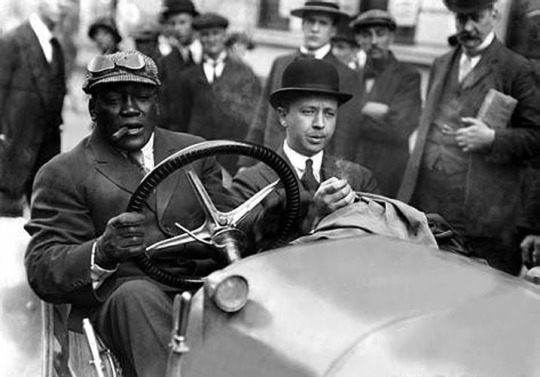
Born in Texas in 1878, deep in the Jim Crow South, his parents were former slaves. He would go on to be the most famous black person of the era, covered in the press more than every other notable black person combined.
In 1903 he won The World Colored Heavyweight Championship. At this point The Heavyweight Championships were not open to black people. Johnson requested matches with white heavyweight champions but they all refused.
James Jeffries, the then champion stated when asked about a potential fight with Johnson that he “doesn’t fight niggers”.
It was only in 1908 that Tommy Burns, the title holder at the time, agreed to fight after Johnson literally stalked him around the world for two years, taunting him in the press for a match.
The New York Times wrote of the match “If the black man wins, thousands and thousands of his ignorant brothers will misinterpret his victory as justifying claims to much more than mere physical equality with their white neighbors.”
Johnson dominated the entire match while openly mocking Burns and his crew, even holding him up to continue throwing punches when he was about to fall to the mat.
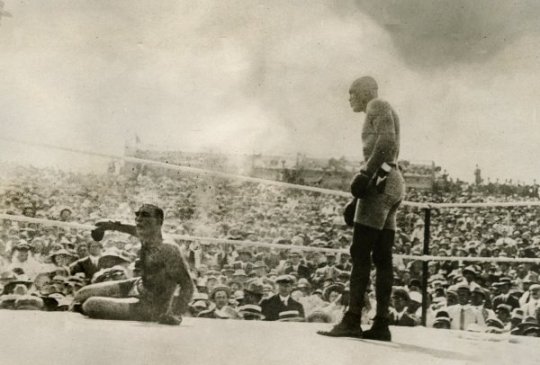
He demolished Burns in 14 rounds in front of 20,000 mainly white spectators in what was the biggest upset to white America of the age.
There was then a desperate attempt to find a white person to take back the title which was seen as a symbol of racial superiority. Johnson beat every one of the five white contenders put forward that year.
In 1910, James Jeffries (the one who said he doesn’t fight niggers) came out of a 6 year retirement after having bowed out of the sport, undefeated.
He was seen as the greatest athlete of all time and the match was the biggest in history, the very first “Fight of The Century”.
Jeffries stated “I am going into this fight for the sole purpose of proving that a white man is better than a Negro.”
The ringside band played a song called “All coons look alike to me” and crowds of whites chanted “kill the nigger.”
Despite this hostile crowd,
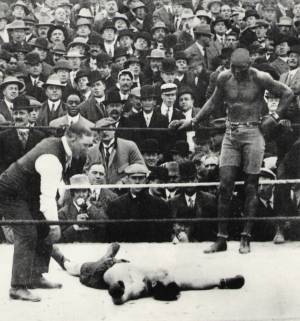
Johnson destroyed Jeffries and toyed with him for the entirety of the match.
In round 15, Johnson scored the first ever knockdown against Jeffries, only to do it again, and then again before Jeffries bowed out.
Jeffries himself admitted after the match that he could never have beaten Johnson, even in his prime; “I couldn’t have hit him. No, I couldn’t have reached him in a thousand years.”
The racial tension surrounding the fight was so tense that after he won there were riots in more than 50 major cities across the country. Celebrations of African Americans were met with violent outbursts from white mobs with over 150 blacks killed.
Congress eventually passed a law banning the viewing of the fight to deter the violence and even debated banning boxing itself. It was the most culturally significant match in American history.
Johnson, who went on to hold the title for five more years, openly challenged white supremacy at great personal risk to stand up for his rights as a free individual and paved the way for generations of others to break color lines in America.
1600s: most witch-hunts ended in this century. no witches were burned in North America; they were hanged or in one case pressed to death
1700s: the American Revolution. Marie Antoinette. the French Revolution. the crazy King George. most pirate movies
1800-1830: Jane Austen! Pride and Prejudice! those dresses where the waist is right under one’s boobs and men have a crapton of facial hair inside high collars
1830-1900: Victorian. Les Miserables is at the beginning, the Civil War is in the middle, and Dracula is at the end
1900-1920: Edwardian. Titanic, World War I, the Samantha books from American Girl, Art Nouveau
1920s: Great Gatsby. Jazz Age. Flappers and all that. most people get this right but IT IS NOT VICTORIAN. STUFF FROM THIS ERA IS NOT VICTORIAN. DO NOT CALL IT VICTORIAN OR LIST IT ON EBAY AS VICTORIAN. THAT HAPPENS SURPRISINGLY OFTEN GIVEN HOW STAGGERING THE VISUAL DIFFERENCE BETWEEN ERAS IS. also not 100 years ago yet, glamour.com “100 years of X” videos. you’re lazy, glamour.com. you’re lazy and I demand my late Edwardian styles
I just saw people referencing witch burning and Marie Antoinette on a post about something happening in 1878. 1878. when there were like trains and flush toilets and early plastic and stuff. if you guys learn nothing else about history, you should at least have vague mental images for each era
“Les Miserables is at the beginning, the Civil War is in the middle, and Dracula is at the end” sounds like the longest weirdest worst movie I’d pay to see in theatres five times.

 Beautifuldifferences