I tried to explain to a friend of mine who has never ever been poor in his life why it is that poverty is a cycle, and why it’s so difficult to escape poverty.
His response was, “just save money”. I kept trying to explain that when you are living paycheck to paycheck, there really is no saving money because most of your income is being spent on basic needs: food, shelter, clothing, transportation.
So, then he responded, “well, why can’t you just save $5 every week”. Well, a lot of poor people do try to save. I would manage to get a few hundred in my savings account, but then you get a flat tire, or you end up getting sick and missing a week of work, or you have an unexpected bill. And, that few hundred dollars suddenly disappears. I tried to explain to him that when you’re poor, unanticipated expenses can very quickly and easily blow through what little you have in your savings account and put you back at square one.
I also tried to explain that when you are that poor, you need to make purchases while you have the money. Like, if I needed a new pair of jeans and I had an extra $30 that week, I would buy myself a new pair of jeans that week because I didn’t know when I would have an extra $20 or $30 to spend. So, he countered that with, “You don’t need to buy clothes. You could have put that $30 in your savings.”
To which I responded, “Well, if it were socially acceptable to walk around without pants on, then maybe poor people could climb out of poverty, but until then, when your jeans have holes in them, or don’t fit you anymore, you need to get some new ones.”
Then it kind of clicked for him.. a little.
So, I went on to talk about the sociological aspects of poverty, like how growing up poor, or growing up as part of a marginalized demographic pushes your starting block 100 feet behind your peers.. how our educational systems are set up to fail impoverished children. The light bulb flickered, but never fully turned on.
And, then he said, “I still can’t believe you were ever on food stamps.”
Yes, my friend, poverty and I get a nice little reunion every few years. I know it intimately, which is why you should sit back, relax, and just listen.
I never understood how it was so difficult to see the realities of poverty. To me, it is sort of common sense. And, what is irksome is that poverty doesn’t always present itself as an old beat up car, and falling apart sneakers. People who grow up middle class and financially secure seem to think that poverty looks a lot like dirty children with dirty clothes, and no shoes. But, it doesn’t. It can be that, but it’s often not.
I grew up in a nice house in the suburbs, but we were poor. We were very poor for a long time, in part due to my medical issues. People assume that because we went to Catholic school, and had a nice house that we were well-off. We weren’t. My mother worked 2-3 jobs, and my parents took out loans to pay for our school tuition. My mother’s parents helped pay for some of our education, even though they were also incredibly poor. My parents sometimes struggled to put food on the table.
I never had clothes that were dirty or falling apart, but most of my clothes and shoes were hand-me-downs from my older cousins. In fact, a lot of my toys were, too.
Both of my parents grew up in poverty. My father, especially, grew up in complete and abject poverty. Their parents grew up in poverty, and so did their parents. My parents made immense sacrifices to set us up for financial success, but life always finds a way to intervene.
Personally, my health issues have been the driving factor behind my own financial issues. I have amassed thousands of dollars in medical debt. I work a job that doesn’t use my degree at all because I can work part time and still get benefits, and because I know I won’t get fired if I need to take extended absences due to my health.
So, when you say, “I still can’t believe you were ever on food stamps,” you are really saying, “I have this picture in my head of what poverty looks like, and you don’t fit that image.”
That idea we have about what poverty is supposed to look like is a big reason why people in the middle class are so content with cutting safety net programs, even though they are one medical problem, one car accident, or one lay-off away from complete financial ruin. What does poverty look like, then. How do you “just save money”, then.
poverty in the developed world doesn’t look like a refugee child with flies on their face.
it looks like a normal person in normal clothes, in a normal apartment, with their bills spread out on the kitchen table, crying.
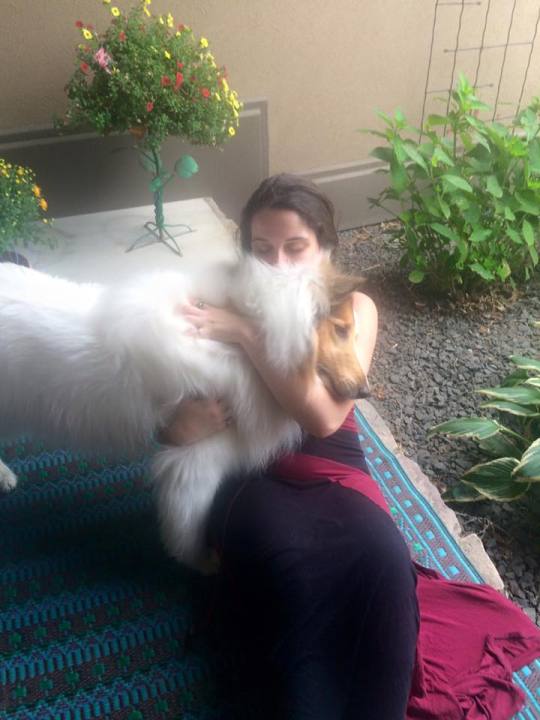
As a dog trainer, I can tell you that probably 50% of dogs really don’t like hugs and at least another 48% pretty much just tolerate them. Very few dogs I know genuinely like hugs the way humans tend to give them. What’s funny is that the picture that Fox used with this headline is one of the more common ways dogs do enjoy contact that humans would consider a hug.
Stanley Coren – the dude who wrote the article that is pissing everyone off about this – really does know what he’s talking about. He wrote one o my favorite books, called how to speak dog, which has some absolutely beautiful diagrams of dog behavior and body language along the gamut of extreme situations.
The way humans hug dogs is often really uncomfortable for them. We lean over them and trap them (think how many dogs we already know are spooky when you loom over them, but are fine if you get down to their level), and then we restrict their ability to move and shove our faces close to theirs. That’s not fun. Keep in mind that most dogs have personal space bubbles that are larger than we tend to think, and now you’re not only invading it, you’re making it so they can’t move or defend themselves if something happens.
Look at this photo from a couple years ago. Avalanche is probably the most tolerant dog I know of things that press his physical boundaries – he lets little kids do things to him that make me cringe and doesn’t even seem to notice half the time. This was right before I had to head back to college and I knew I wouldn’t see him for another 6 months, so I hugged him because sappy human emotions. I have an amazing relationship with this dog, and look at his body language. He’s kinda stiff, his face is a little tense, and the corners of his mouth are pulled back a little. All in all, he’s supremely un-enthused but he’s letting me do it. After about five seconds, he huffed out the sigh he uses to let me know when he’s done with the hug, and then pulled back and shook off.
Most dogs learn to tolerate hugs because we do it to them so often. It’s pretty much a kind of learned helplessness, plus, they like us and so they put up with our stupid human behavior. When you hug most dogs, you’ll notice they get kinda stiff, they look away or at other humans for help, you’ll see side-eyes or look-aways (not whale eye). Often they’ll distract you by doing something else like pawing at you, or licking your face as an appeasement signal. They’re all signs of discomfort that we already routinely ignore when we deal with our dogs, so it makes sense that people think their dogs are fine with it – they’re just still not listening.
More often, you’ll get dogs that will crawl up your chest when you sit and put their paws on your shoulders. Sometimes their face is close to yours, sometimes it’s on your shoulder. In that position – which they often initiate – they ca easily withdraw and get away if necessary and they’re not trapped or being leaned over. It’s not really a hug, just close contact, but I think it’s about as close as humans are going to get to one that a dog will enjoy.
This is why it’s so important not to anthropomorphize your pets and actually take the time to learn THEIR body language and natural behaviors.
And if y’all take the time to learn this, you’ll find most dogs have their own ways of showing affection that are equivalent to hugs. My dog doesn’t like to be held tight but she does come up beside you and press her head against your body and lean against you and that’s basically her version of a hug. She’s nervous and doesn’t like to be forced into any interaction but she will sometimes come and snuggle her head in my lap just because she wants to. And if you force interactions and hugs and cuddling with your pet, you’ll miss out on those particular shows of affection that they offer on their own which are way way more special than a forced hug.
Yes, this.
I don’t have much experience with dogs, because I’ve never lived with one, but with cats? Obviously, hugging like the above doesn’t work, but a lot of cats are partial to being carried. Thing is, you have to be very attuned to their communication to tell when they’re comfortable and when they’re not.
My lovable orange floofball, Butterfinger, likes it when I carry him cradled like a baby — he’ll purr up a storm when I do it — but doesn’t like being carried any other way. He is very emphatically not a lap cat, but if I’m sitting in my big comfy chair he’ll come around and nuzzle me before catloafing on the arm of the chair. When I’m asleep, I always sleep on my side, so he’ll come and lie down on top of my flank, and often doze off himself. He follows me around the apartment, but in a sort of holistic sense: he tries to always be in the same room as me, and will often catloaf or doze off within arm’s reach of me, if not snuggled up against me (such as if I’m reading or playing with my phone or 3DS in bed).
❤ Cherish your pets but don’t make them feel scared or unsafe ❤
I think a big part of why I read way more fanfiction than books is that there’s just a hell of a lot less exposition
the first 10 pages of most books are always “these are the main characters and here’s some background on each of them and this is the setting etc etc” and it’s such a fucking hassle getting to the plot sometimes
fanfic is just like “fuck it you know all of this already let’s go”
That’s a really good point.
Same here but there’s actually a point here of well written exposition. Take AUs for example. Even in the most complicated, as-far-removed-from-canon settings we get at most a single paragraph before the actual fic where the author gives us a quick rundown of the rules for that universe. The rest we are left to figure out on our own and it works.
We’re not spoon fed every trivial detail when all we want is to get to the plot. Everything that’s important is said at the moment it is important, not sooner not later. Especially in long fics characters often take on such a unique characterisation that you get to know them all over again but the readers do so organically, in the situations that define those characters as they happen. Same with looks. The fic author generally assumes the readers know what the characters look like and don’t spend paragraphs describing them, and only bring it up when it fits the plot.
I’ve read a few fanfics from fandoms I’ve never been in and surprisingly it still worked out. I had generally a good idea of who these people were, what they did where and why and how they worked together.
Point is, if you’re a writer writing original fiction, pretend it’s fanfic and everyone knows your setting and characters already. That way you’ll only have to add a few details if and when your beta readers mention needing more information and chances are they won’t need a lot.
Point is, if you’re a writer writing original fiction, pretend it’s fanfic and everyone knows your setting and characters already. That way you’ll only have to add a few details if and when your beta readers mention needing more information and chances are they won’t need a lot.
Bolding this fantastic advice.
Reblogging for the next time I write something original.
This is brilliant. I do a shit amount of world building but been blocked for the past week worrying about details and stuff.
Remember: you can always add in revisions. You just have to write first.
Like I keep saying; write like first chapter like you’re already halfway through the story.
not that i’d actually wanna live in a different time period, thanks very much, but also lately im vibing the idea of being born hundreds years ago when an army trudges through my city and kills all my loved ones and i must assume a male disguise in order to seek revenge in this male-dominated society so i cut my hair short and slick it back and join the army and learn how to use a big heavy broadsword and i soon have a reputation as a great swordsman which is only overpowered by my reputation as a great lover despite the fact i never take all my clothes off but i still manage to get all the women and the other guys in my regiment can’t figure out how i’m so good with them but i just gotta shrug and play up the ladies man thing until one day i meet a princess of the blood and im charged with protecting her on a journey out of the capital but we get separated from the rest of the regiment and i start developing feelings for her because she’s spunky but i know It Can Never Be for a number of reasons and then one night she catches me bathing in the moonlight and i instinctively draw my sword because No One Can Know My Womanly Secret but also she’s the princess and also also now i’m in love with her so i simply hand the sword over but she throws it aside with a clatter and throws herself at me and we make love by the lakeside and the next day i put on my soldiers gear and we keep moving wondering what the future will hold when the enemy horde comes upon us and i defend her but am outnumbered when suddenly our separated guards catch up and we fight the invaders and i kill the man who slaughtered my family because he is conveniently part of this regiment and we’re all happy for our victory but i still look sadly at the princess because It Can Still Never Be and i must take her to the capital to meet her betrothed and we kiss and make love sadly in a tent one last time but then we finally reach the city it turns out her fiance is a huge Gay too and has a huge entourage of gays following him around and brushing lint out of his fur coats and he hires me to be the queen’s bodyguard wink wink nudge nudge and i meet her nightly using a secret passageway under the castle and also i get a really cool new sword and history doesnt remember me as anything more than a friend to the queen until centuries later when a bunch of love letters are found in a secret compartment under the castle by a lesbian librarian who was researching the local history and she falls in love with the lady castle tour guide as they bond over an interest in our love story the end
Millionth thought about “Burn” I’ve had this month: Eliza goes for Hamilton’s jugular – but not by repeating the insults we’ve heard before, (arrogant, loud mouthed, obnoxious, son of a whore, bastard, etc…) She rips Hamilton up on the thing he’s most known for, what he’s most proud of – his WRITING. His SENSELESS sentences, his SELF OBSESSED and PARANOID tone. She’s tearing him up about not just the CONTENT of the Reynolds Pamphlet, but the way in which he wrote it. She takes the time in the middle of her rage to mock his style, which is such a rap battle move.
And what is she going to do with all of the beautiful writing he gave her over the years, his letters?
Burn them.
I think about this LITERALLY of the time. About how she pushes the button she knows will kill him.
“not only did you totally drag our names through the mud, and ruin our reputation, it wasn’t. even. your. best. work.”
^^^^^^^^^ killed ‘em ^^^^^^^^^
Okay but that isn’t even the most hardcore part:
The entire play is a fourth wall-breaking battle for narrative control of personal and professional legacy. That’s what it’s about. Conventional wisdom — and basic logic — states that history is written by the winners. Hamilton: An American Musical shows us the battle for that proverbial quill.
Literally the first song tells us “His enemies destroyed his rep/America forgot him” because up until the release of this play, Alexander Hamilton’s legacy was mostly overlooked by the average American, largely thanks to folks like Jefferson and Madison underselling his contributions after he died.
(This is also why Jefferson isn’t shy and awkward in the play. While that would have been historically accurate, the point is that the modern perception of Jefferson is that he’s a Big Fucking Deal. Because he made himself look that way.)
So the characters on stage are constantly fighting to make their version of events the version of events.
Burr is the narrator because this is his opportunity to tell his side of things. “History obliterates in every picture it paints, it paints me in all my mistakes.” He’s saying that in the end he LOST the fight for narrative control. And yet — and here’s the fucking amazing part — the mere act of explaining this to the audience CHANGES OUR PERCEPTION OF BURR and alters his place in history. God Lin is too smart for his own goddamn good.
(“History has its eyes on you,” Washington says, putting a very fine point on things. And if you don’t think he also means there’s an audience sitting watching this play, you’re not paying attention.)
So, let’s talk about Alexander, his obsession with legacy, and his tried and true method for controlling the narrative:
Writing.
In “Hurricane” he says “I’ll write my way out! Write everything down far as I can see! … Overwhelm them with honesty! This is the eye of the hurricane, this is the only way I can protect my legacy!”
“It doesn’t work” you might say, going by the contents of “The Reynolds Pamphlet.” Except… it kinda does. “At least he was honest with our money!” the company sings. Which was really Alexander’s main concern, after all. Think of his priorities in “We Know” where his first instinct is to gloat because “You have nothing!” It’s not until a beat later that he even considers Eliza.
He published the Reynolds Pamphlet because he didn’t want people to think he was disloyal to the United States. His concern was with his professional legacy. And in that sense… he succeeded.
(He succeeded in another way, too. Listen to “Say No To This.” (God I could write a 40 page paper on that song alone.) This is where we actually hear the contents of the Reynolds Pamphlets. And how does the song begin? With Burr explicitly handing narrative control to Alexander Hamilton. “And Alexander’s by himself. I’ll let him tell it.”
Every line of dialogue from Maria is prefaced with Hamilton saying “she said.” That’s because HAMILTON IS WRITING HER DIALOGUE. Hamilton is creating this character of a sultry seductress in red, coming to him when he was weak and luring him to adultery. Maria Reynolds in the play not a character, she’s a fantasy, created to excuse Hamilton’s transgressions.
It’s worth noting at this juncture that Maria Reynolds, the real woman, wrote her own pamphlet. No one would publish it. She was silenced. And Hamilton’s depiction of her as a morally corrupt temptress became the dominant narrative.
So suck on that literally any time you want to fucking blame Maria for Hamilton’s affair: good job, you’ve bought into a serial adulterer’s lies about a battered woman. Also don’t do that, I swear to god I will come for you.)
SO. What does any of this have to do with Burn?
In the very end, it’s revealed that it wasn’t Jefferson or Burr or Hamilton in control of the Almighty Narrative.
It was Eliza.
The very last second of the play is Alexander Hamilton turning Eliza to face the audience. She sees the people watching, and she gasps. Because she did this. She’s the reason this play exists. She’s the reason Lin Manuel Miranda is telling us a damn thing about Alexander Hamilton, she’s the reason Hamilton got a massively popular zeitgeist musical.
Now. Throughout the course of the play Eliza sees all these people weaving their important stories and she thinks she’s somehow… outside. She’s not a statesman, she’s not brilliant like Angelica, she’s just a wife and a mother and she has no place among these giants. At one point she LITERALLY ASKS HER HUSBAND TO BE INCLUDED I’M GONNA SCREAM.
And yet she never had to ask. She was in control the whole time.
And how, how did she do it? How did she “keep” Alexander’s “flame?” By collecting and preserving everything he WROTE, of course. Making sense of it all. She spent fifty years on the project. Everything she collected BECAME THE NARRATIVE.
But you know what wasn’t in there?
That’s right: those letters she burned.
So she didn’t just insult him, oh noooo. Eliza WHOLESALE OBLITERATED A PIECE OF ALEXANDER HAMILTON FROM THE NARRATIVE.
And not just any piece. “You built me palaces out of paragraphs, you built cathedrals,” she sings. In “Hurricane” Hamilton lists his letters to Eliza among his greatest accomplishments, (conflating his writing them with actually BEING HER HUSBAND, god what a self-centered prick). “I wrote Eliza love letters until she fell.”
Eliza says: “I’m burning the memories, burning the letters that might have redeemed you.”
The best pieces of Alexander Hamilton: gone.
God I’m gonna go curl up in a ball and freak out about this some more. FUCK.
guys ilu… but this is wrong…Eliza *didn’t* burn Alexander Hamilton’s letters to her in the musical, she burned her own letters, the ones *she* wrote.
The lyrics:
I’m erasing *myself* from the narrative
Let future historians wonder how Eliza
Reacted when you broke her heart
You have torn it all apart
I am watching it burn
Watching it burn
The world has no right to my heart
The world has no place in our bed
They don’t get to know what I said
If you read the bio Hamilton is based off of, there’s a gap after the affair is exposed because almost none of the letters Eliza wrote to Hamilton survived and the author is left to speculate (he speculates that Eliza forgave him because that was what was expected for wives at the time. Also Angelica wrote him a nice letter immediately after it came out and she defended him to others, and so did the father-in-law Philip Schuyler. If Eliza was mad, her family wasn’t supporting her.) So Miranda had almost nothing to go off of and what he did have… didn’t seem very fair and would be unsatisfying to the audience. He took some artistic license. Obviously we can’t know when or even *if* Eliza burned her letters. All we know is that she saved every letter he wrote to her and did not save the ones she wrote back… and future historians are left to wonder how Eliza reacted.



 Beautifuldifferences